A few years ago, Jill Heaton Gross and her husband, Charley, bought the Illinois homestead where her family once lived. The century-old barn she remembered fondly still stood on the Warren County property.
“I was more excited about the barn than the house, to be honest, because it held so many memories,” Heaton Gross says. “As soon as I found out it was available, I knew I wanted to fix up the barn.”
To restore the barn, the couple turned to Firmitas, a specialized heavy timber construction and historic preservation company. Located in Galesburg, Firmitas is known globally for its work restoring historic structures, including bridges, churches, warehouses, mills, residential buildings and barns.
Firmitas’ master carpenter Rick Collins, an Illinois Farm Bureau member, says his team has worked on barns dating back to Colonial America.
“The oldest barn we’ve worked on in the United States dates to 1780,” Collins says. “The oldest building I’ve worked on was from 1100, and that was a barn in England.”
See more: Stade’s Farm & Market Offers a Theme Park Experience on an Illinois Farm
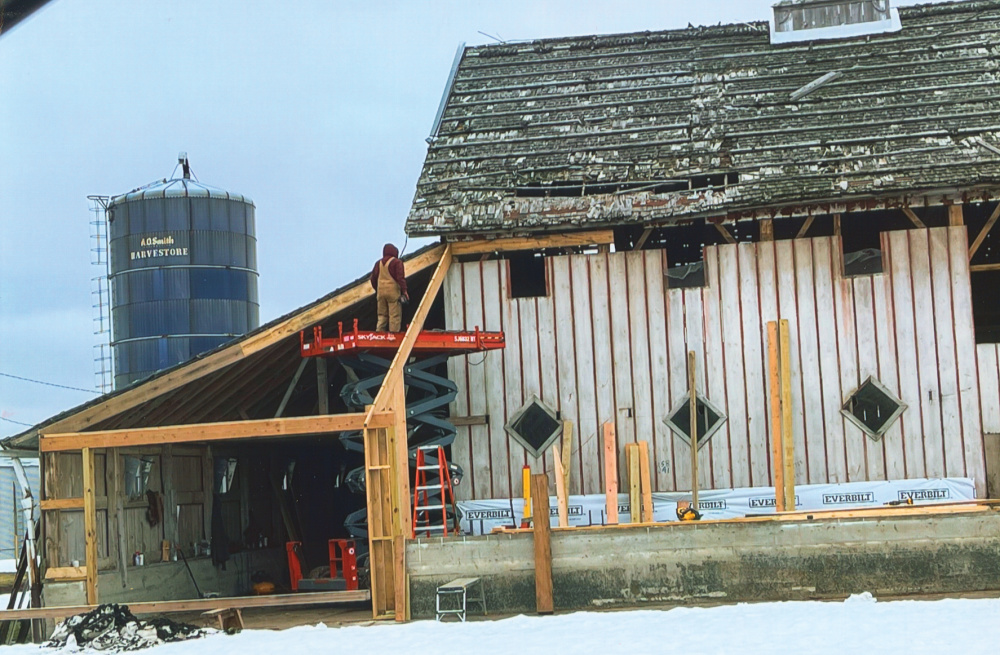
Reviewing the Framework
Collins has spent a lifetime saving structures, driven by his admiration for quality wood construction, his agrarian roots and his exceptional carpentry skills.
“I grew up in Toulon (Illinois) surrounded by Victorian buildings with a high level of woodworking,” he says. “I started doing restorations with my parents as a kid.”
As a teen, he worked for a custom hay baler, seeing stunning timber structures on a regular basis.
“I was in a lot of old, timber-frame barns on different farmsteads,” he says. “I think the thing that really drove me to start saving buildings was the ag crisis of the 1980s, when I saw so many foreclosures and a lot of these barns burned for fire department training. That was fairly traumatic for me to watch the world I knew just crumble away.”
In 1996, Collins drew on his varied experiences, including service as a U.S. Marine Corps Reserve combat engineer and a graduate of the University of Illinois with a degree in wood science, to start his first business.
“Our initial goal was to build new timber-frame buildings, but the restoration work kept finding me,” he says.
Now, Firmitas handles both restorations and building new timber-frame structures that replicate the same types of buildings the company restores. Collins estimates he works on about 200 barns each year.
“We’ve helped counties, townships, universities and private landowners save hundreds of barns a year across the country,” he says, noting the restoration of barns is part of built heritage, the human-made structures holding historical, cultural, architectural or social significance in society.
Collins says the gable entry, aisled barn is architecturally significant because it represents a transitional period in building construction.
“The floor plan carries echoes of medieval buildings, but the concrete floor and hay tracks illustrate how agriculture was changing at that time,” he says. “Transitional buildings are rare, as they were only built for 30 years or so.”
See more: Illinois Farm Stays Welcome Visitors to Enjoy a Rural Retreat (VIDEO)
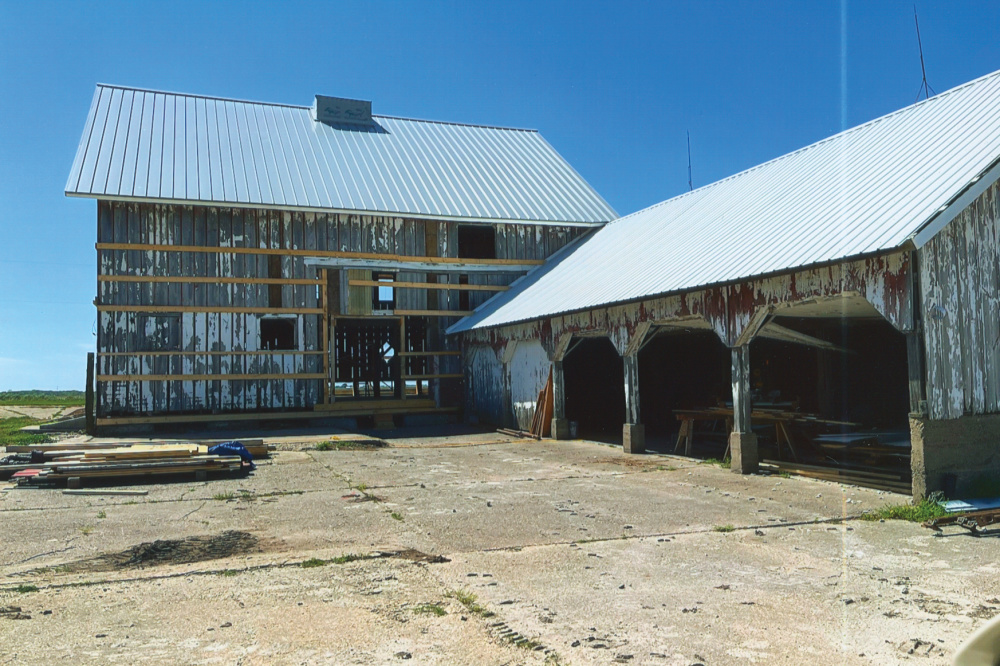
Structural Significance
For restorations, Firmitas determines the scope of work and then establishes priorities.
“We assess where the greatest damage is occurring,” Collins explains. “If it’s the foundation, then we start there. If it’s the roof, we fix the roof. Those are the main places first – head and feet. You have to keep your head and feet dry. Walls, windows and doors are secondary.”
In addition, they determine the desired time period the client would like the barn restored to.
“Some people want a structure restored to how they remember it,” Collins says. “Others might want the farm structure to look like it did when a great-great-great uncle came in 1840. For example, Jill had a photograph of the barn from her childhood and wanted the barn restored to that.”
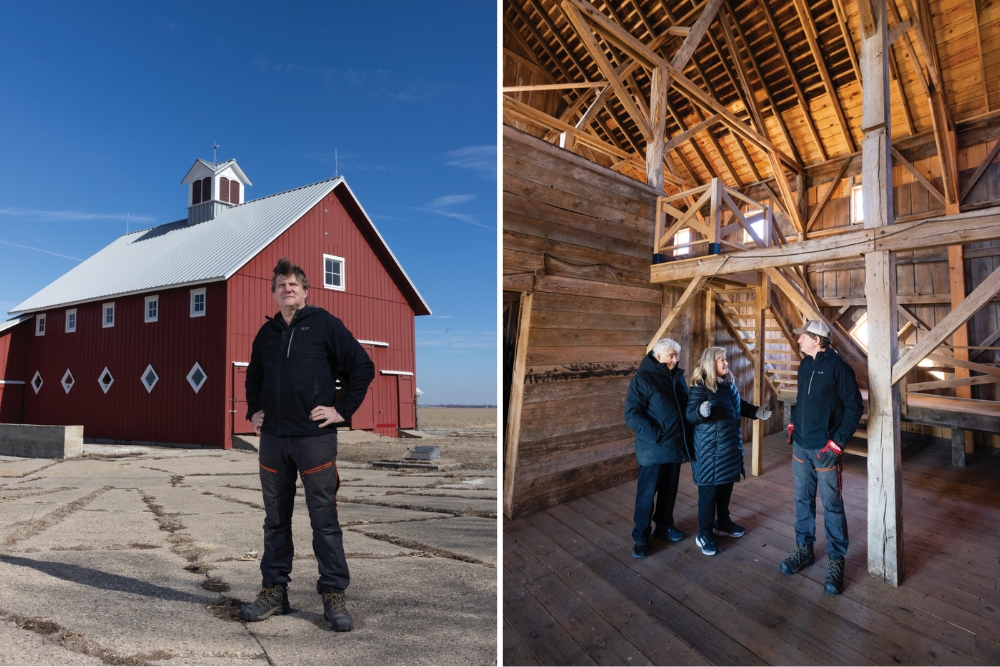
The Gross barn, circa 1906, was near collapse when his crew began renovations.
“The cupola had fallen off and left a gaping hole in the roof, which was rotting pretty badly,” Collins explains. “Some of the rafters were broken. Portions of the inside had been stripped, and lean-tos added in the 1950s were disintegrating, which also caused damage. The barn didn’t have many years left had we not gotten to it.”
Firmitas replaced two wall posts and some horizontal beams called girts. The west side lean-to was removed, which revealed diamond-shaped windows. The cupola was rebuilt and placed on the new roof. And although the barn had been white for decades, red paint appeared as the building weathered, so the barn was painted a resplendent red.
See more: Pasture Grazed Regenerative Farm Leans Into Technology, Family and Community
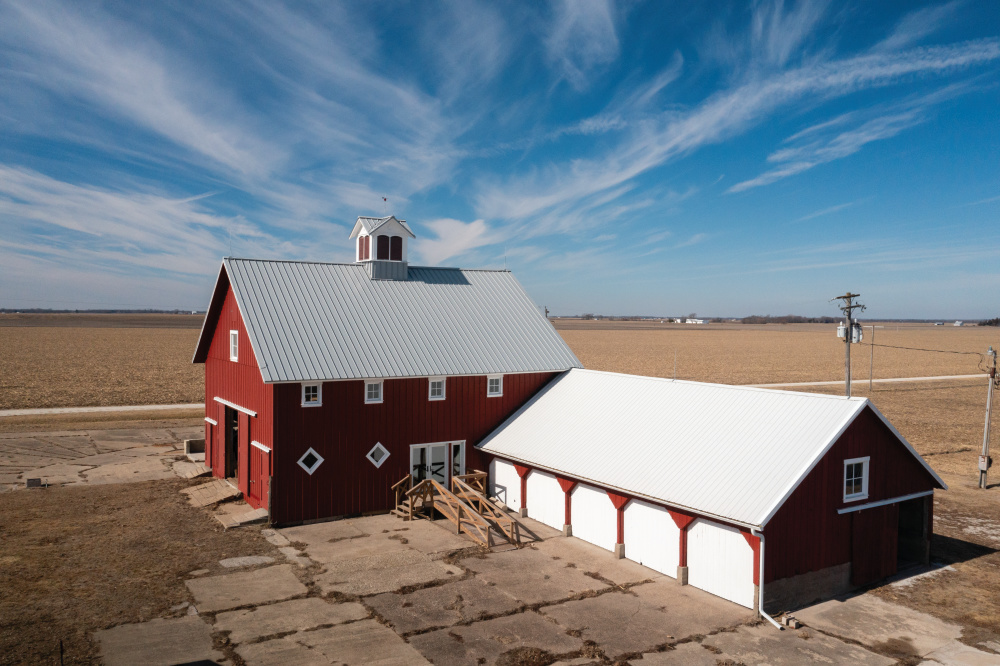
Restoring Heritage
For Heaton Gross, the barn carries social significance.
“I wanted to preserve this barn to honor the legacy of my parents, Keith and Gwen Heaton,” she says. “Renting this farm was a big break for my dad. We moved here in 1957 when I was a year old, and my older sister, JoAn, and I grew up here. We had 4-H calves a few years and a pony named Snip, and they were all in the barn.”
When Heaton Gross was 20, her parents built a home a few miles away. That farm remains in the Heaton family. Heaton Gross and Charley live in the Chicago suburbs, but their son suggested they also find a small home close to the family’s farm.
“Then the house where I grew up and the surrounding 4 acres became available for purchase, and it was just perfect for us,” she says. “I spent a lot of time in that barn as a child, and I’m very, very lucky to be able to preserve it.”
Heaton Gross hopes the barn continues to be a special place for the family for years and generations to come.
“I see it as a family gathering place, and I’m so thankful my 101-year-old dad saw it preserved before he passed away,” she says. “When I look at the barn now, I just feel a sense of legacy.”
For more information about Firmitas, visit firmitastimber.com.