


If you ate three bites of food today, thank a pollinator. Because of pollinators, we enjoy countless fruits, vegetables and nuts – one of every three bites of food.
Bees, birds, butterflies, beetles and bats pollinate by traveling from plant to plant, carrying pollen on their bodies. This vital interaction allows the transfer of genetic material critical to the reproductive system of many flowering plants.
But these essential species face challenges from loss of habitat and disease. In recognition of National Pollinator Week, the last full week of June, we look at efforts to promote pollinator populations in Illinois.
Growing and Protecting Habitats
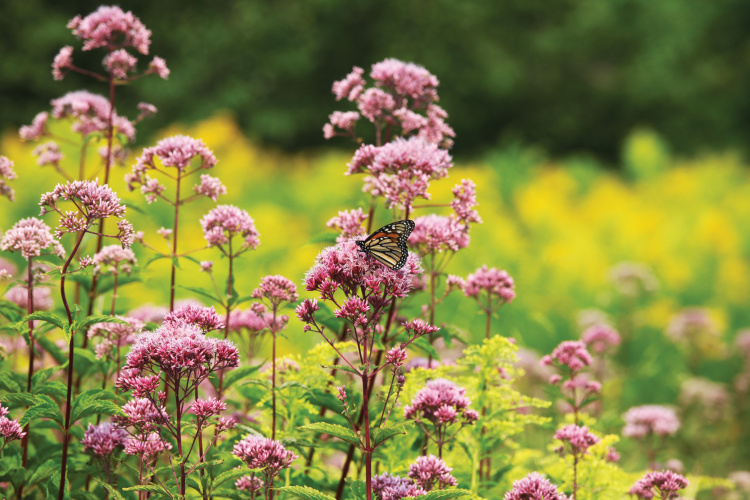
The brilliantly colored monarch butterfly – the state insect – migrates from Mexico to Illinois in the spring, taking two or three generations of butterflies to make the journey. Then, by late summer, a “super generation” emerges, equipped to travel an estimated 2,500 miles back to Mexico for overwintering.
Milkweed serves as the sole host plant for monarchs, which lay eggs on the perennial. The eggs hatch into caterpillars, and the caterpillars eat the foliage.
A dwindling monarch population prompted the formation of the Illinois Monarch Project (IMP), an initiative of stakeholders representing four sectors: agriculture, rights of way, urban and natural lands. Stakeholders involved in IMP include Illinois Farm Bureau and state agencies, such as the Department of Natural Resources, the Environmental Protection Agency and the Department of Agriculture, among others.
IMP has set a goal of adding 150 million new stems of milkweed and other nectar resources by 2038. As part of the multifaceted Monarch Project Action Plan, IFB helped design mowing guidelines to assist landowners in utilizing best practices when mowing to protect habitats for monarchs and other pollinators, according to Raelynn Parmely, IFB environmental program manager.
Similarly, the Illinois Department of Transportation mows at select times and limits its mowing beyond the roadway edge in accordance with the Illinois Monarch Project Mowing Guidelines for Pollinators.
Parmely says IFB also created a habitat guide for farmers and other landowners who want to establish pollinator habitats. Backyard gardeners planting small pollinator plots have many resources, but Parmely says agriculturists needed guidance in establishing larger plots of a quarter-acre or more.
IFB has also launched a Pollinator Conservation Grant Program with 13 county Farm Bureaus working together on nine pollinator projects totaling $25,000. For example, the Clinton County Farm Bureau will establish a pollinator habitat near its cover crop plot and study the habitat’s potential as a buffer for invasive species.
See more: Monitoring Monarchs Butterflies in Illinois
Planting the Seeds
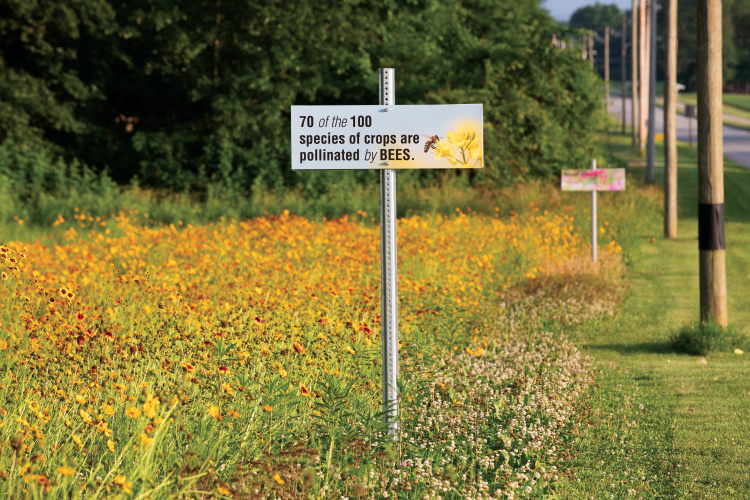
The Farm Bureaus in Wayne and White counties also collaborate to increase pollinator habitats and use those plots and gardens as educational opportunities in their communities. Doug Anderson, Farm Bureau manager for both counties, says the White County Farm Bureau established a pollinator garden on a 90-by-100-foot lot next to its building. Their top priority: to attract monarchs.
“We worked with our FS cooperative, who provided us with a seed mixture to also attract honeybees,” Anderson says of their initial plantings in 2018. “It’s done very well.”
The two counties, along with seven other county Farm Bureaus, Wabash Valley College and Wabash Valley Service Company, joined together to form the Wabash Valley Stewardship Alliance (WVSA). In 2020, this coalition installed a 1-acre pollinator garden at Wabash Valley College in Mount Carmel. Ag faculty reinforce the importance of pollinators in their classes, but the garden quickly became popular with the community, too. In 2021, WVSA installed a similar pollinator plot at Frontier Community College in Fairfield.
WVSA also offered “pollinator grab bags” with seed mix including such flowering species as sunflower, coneflower, aster, alyssum and wallflower.
“We had tremendous response in giving these away for free to anyone who wanted one,” Anderson says. “We’ve taken the attitude that every little bit helps. I don’t think enough people understand how critical pollinators are to the food supply in the United States. As county Farm Bureaus, we need to keep this issue at the forefront. One of the ways we can do that is by doing programs like we’ve done here. It comes back to education.”
See more: The Birds and the Bees: Pollinators Benefit Home Gardens

Learning Opportunities
With the goal of increasing education about pollinators, GROWMARK, an agricultural cooperative, designed a program to help youngsters do their part in promoting pollinator populations.
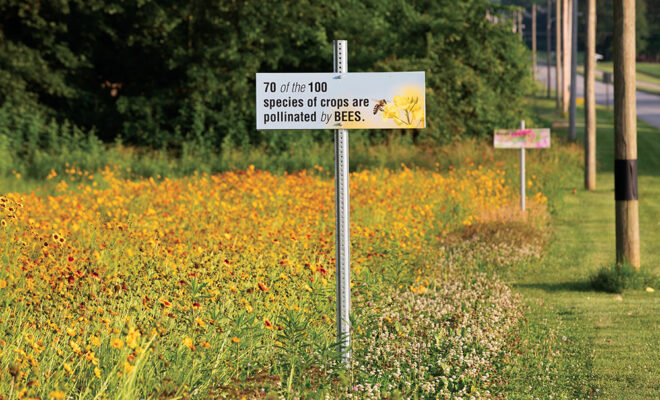
Since 2016, GROWMARK has provided seed to 4-H clubs, Ag in the Classroom groups and FFA chapters in four states, including Illinois, and in 2022, it expanded nationwide. Organizations locate a public space – a park, school, county fairground or other visible location – and obtain permission to plant a pollinator garden. GROWMARK provides enough seed to plant a 700-square-foot area along with educational signage.
To date, 341 different projects have been part of the program, says Karen Jones, GROWMARK youth and young producer specialist. With the 2022 expansion, more projects will be coming soon.
“We focus on youth organizations because we’re not only promoting pollinators, but we’re also teaching others the importance of pollinators as well,” she says. “Community outreach is a big part of our goal with this simple program that’s been popular every year we’ve done it.”
Many farmers want to lead the way in protecting pollinators because they consider their most important role to be taking care of the environment to continue producing food far into the future, Jones says.
“Making sure we have a healthy pollinator population is a key part of ensuring these species are able to survive so we can produce the food and fiber we need,” she says.
Pollinators by the Numbers
Illinois counts 24 species of milkweed, most of which benefit monarchs.
In 2017, Illinois established milkweed as the official state wildflower.
Illinois farmers and other landowners enrolled more than 100,000 acres of farmland in the Pollinator Habitat Program as part of the Conservation Reserve Program, managed by the U.S. Department of Agriculture’s Farm Service Agency.
Bee-pollinated commodities account for $20 billion in annual U.S. agricultural production.
Sources: Illinois Monarch Action Plan, U.S. Department of Agriculture – Farm Service Agency
See more: 7 Pollinators to Help Your Garden Grow

My husband and I live on 6.5 acres about 20 miles west of Kankakee proper. We have a small pond on the property along with a creek (farm drainage). About 2 to 2.5 acres are really not productive in any way that we can find. We’ve tried growing hay by hiring local farmers to cut and bail it, but it all depends on how much rain we get. That part of the property can stay wet all summer if it is a rainy year. This year (2023), it is dried out due to minimal rain so we’re mowing it (which we prefer not to do). We’d like to turn these acres into a pollinator habitat but do not have the knowledge or resources to make this happen. We are hoping that perhaps you might be able to provide some resources, information, and contacts, to make this property productive and useful for society’s needed critters and we are confident it will make our property a special place for our 9 grandchildren to learn. Thank you for taking the time.
Hi Sherry, we’d recommend contacting your county Extension agent for more details. https://extension.illinois.edu/gkw
Hope this helps!
Jessy Yancey
editor, Partners magazine