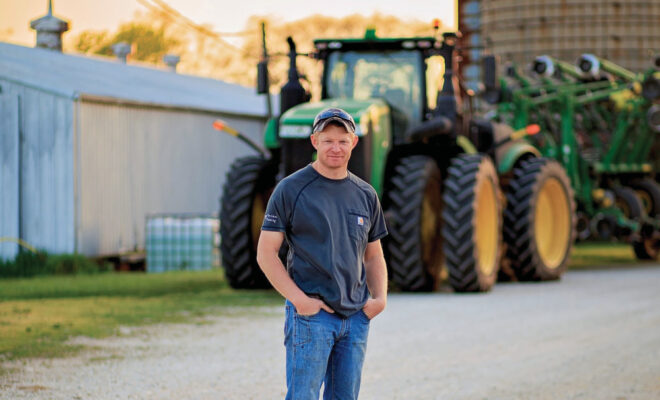
The resiliency of both the family farm and his rural community is never far from Jon Griffel’s mind.
“You know, Illinois is one of three or four states actively losing residents. But I’m staying in Illinois,” the 28-year-old Gillespie farmer says. “I can’t pick up the farm and move it somewhere else. This is where I’m going to be, so I’m going to do what I can to make it better.”
Jon represents the sixth generation on his family’s farm and serves as a member of the U.S. Farmers & Ranchers in Action (USFRA) Ambassador Network representing the Illinois Farm Bureau. He works with his dad, Dave, on a mid-sized farm located about one hour north of St. Louis.
While 62-year-old Dave makes a full-time living on the farm, Jon supplements his family’s income as a real estate agent, and his wife, Kristin, contributes to the family’s earnings as a surgical nurse. The young couple wants to keep the farm thriving for the seventh generation.
“Farmers are really the bedrock of communities, because we’re here for the long haul,” he says.
In addition to Jon’s dual professions, he believes deeply in giving back to his community through volunteer service. As part of the IFB Young Leader program, and president of the Macoupin County Farm Bureau Young Farmers, he organizes his county’s annual tire recycling drive. The environmentally aware project allows citizens to clean up back yards, farmyards and reduce bulk in their local landfill.
Last year, Jon marshaled local volunteers to collect passenger vehicle tires. This year, they collected semi-truck and tractor tires that will be recycled into plastic mulch. It may not be the most exciting way to spend his Saturday, but Jon is happy to do it. Recycling keeps tires from “ending up in burn piles or dumped on the side of the road,” he says. And more importantly, it helps out his local community.
IFB honored Jon in 2021 as an IFB Top County Young Leader Chair for his leadership efforts. He and other USFRA Ambassadors, such as Pennsylvania farmers Justin and Amanda Jones and Colorado dairywoman Mary Kraft, serve as agricultural leaders amplifying efforts to create sustainable food systems and maintain vibrant rural communities.
See more: Nourishing Nutrients: How Farmers Manage Soil Health to Grow Better Crops
Climate-Smart From One Generation to the Next
Together, Jon and his father grow soybeans, corn and wheat. They also raise beef. Their climate-smart farming practices include no-till and other conservation tillage, which they say is critical for maintaining highly erodible sections of their farmland. To further maximize soil heath and reduce the need for costly inputs such as fertilizer and pesticides, they test soil, practice crop rotation and variable rate application.
“We’re here to take care of this resource so it can continue to be passed along,” Jon says.
With much of a farm’s value tied to the land itself, the effort and acuity it takes to transfer the operation’s assets, while bridging the financial needs of the parent generation and the next generation, can be a challenge.
“Succession planning is one of the biggest factors that the older generation doesn’t want to talk about and the younger generation doesn’t know what to do about,” Jon says. “If people don’t want to come back to farm, I absolutely understand. There are a lot of easier jobs that make a lot more money; but I hate to see a young farmer not get the opportunity to farm because the family wasn’t able to protect the land and pass it down.”
Dispersing the Load Across Generations and Occupations

The cost of preserving a small family farming legacy occasionally requires some creative financial alternatives. Jon’s off-farm job as a part-time real estate agent has been the link that keeps the farm in the family, while two generations derive farming income.
With five generations of stewardship as a foundation, Dave’s intention to eventually step down and hand over the reins to Jon motivates Jon to divide his earning potential between two economic sectors. He appreciates having a flexible second job, which allows the pathway forward.
“If I wanted to go out and start a business in town, and in three or four years it failed, I would be sad, but there would not be the heritage and the family ties behind the business, like what exists in a family farm,” Jon says. “That heritage is very important.”
See more: Illinois Farm Families Program Helps Connect Consumers to Farmers
Jon Griffel Shares the Message Beyond the Farm Gate
With his role as a USFRA Ambassador and through his work with Farm Bureau, Jon is enthusiastic about sharing the story of agriculture with the non-farming public. Jon opines that for most U.S. consumers, their only interaction with farmers is “when they’re getting mad because they’re behind our tractor and we’re making them late to work.”
Even in his small, agriculture-based community, many of his neighbors have a limited understanding of what farmers do or how other sectors of the food supply chain affect on-farm economic sustainability. In 2020, on average, farmers received just 16 cents per every dollar spent on raw food commodities, while farm-level production costs comprised 8 cents per dollar. This means farmers net an average of only 8 cents per consumer dollar spent.
“Last year, I had people coming up to me and saying, ‘Oh, you must be happy; I’m paying $8 a pound for ground beef at the store.’ I had to tell them, ‘It doesn’t matter to me. I’m still getting only $1.25 a pound at the scale,’” Jon says.
The central Illinois farmer would like to see farmers at the forefront of rural economic revitalization, encouraging a more resilient local food chain and thus bolstering local economies. But he knows that income-producing labor alone is not the whole measure of community’s vigor. So, whether it’s helping other young farmers, joining his local chamber of commerce, judging the county FFA poultry show, or seizing opportunities to talk about farming with the public, Jon is committed to doing his part.
“I don’t like to complain about things. I like to provide solutions,” Jon says. “You can’t sit back in agriculture and in small communities. You can’t sit back and just let things happen. You have to be proactive, or next thing you know, you’re behind the eight ball.”
See more: The Dusty Truth: Rural Roads Are Critical to Commodity Transportation