Similar to a doctor’s order for bloodwork, farmer Mark Litteken tests his fields every three years to monitor the health of his Clinton County soil.
Crops need nutrition, too, which requires careful management by Illinois farmers to ensure plants have access to the nutrients they need. Just as backyard gardeners check the fertilizer packages at retail garden centers, farmers pay close attention to key nutrients like N-P-K, nitrogen, phosphorous and potassium. Farmers and agronomists further review and develop management plans for organic matter, pH and even micronutrients like iron, zinc, cobalt and magnesium.
The goal: Make the desired nutrients available and accessible when crops need them, yet keep those necessary nutrients out of rivers, lakes and streams – the premise of the Illinois Nutrient Loss Reduction Strategy.
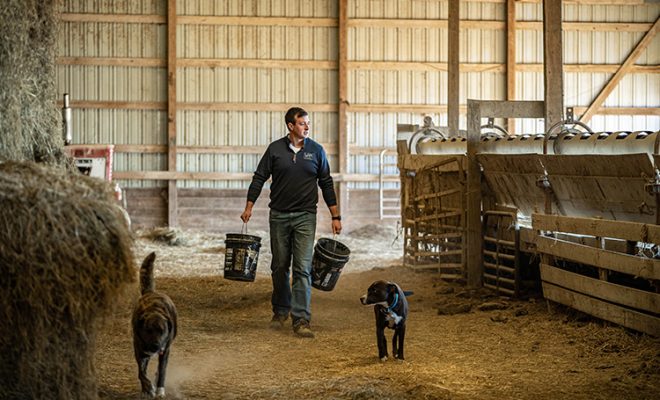
“Our biggest concern for livestock on our farm is not what we have above the ground but what we can’t see below the ground,” says Litteken, who farms with wife, Jenny, to raise beef cattle and hogs on the crops they grow, including forage, barley and corn.
They sell the farm’s pork and beef at their retail store, Sugar Creek Valley Meats in Breese. “If we can produce healthy bacteria and stimulate the natural biology in the soil, we can produce more nutrient-dense plants, which makes more nutrient-dense meat and more nutrient-dense crops. The more nutrients we can provide for our animals, the more we can provide for humans and the healthier we can live.”
See more: Cover Crops Protect Soil Between Growing Seasons (VIDEO)
The Dirt on Soil Nutrition
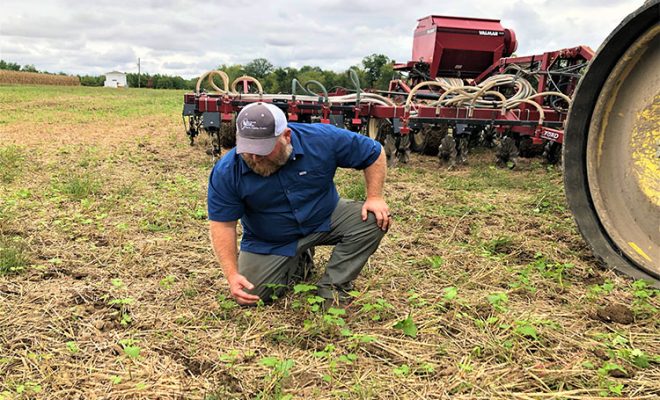
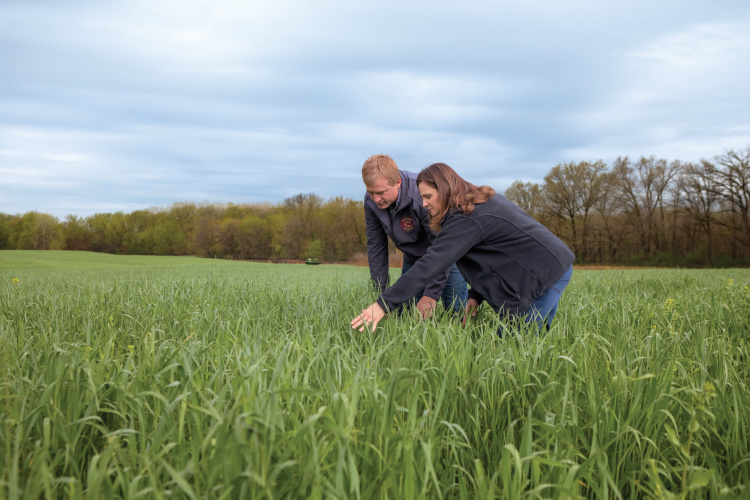
An advocate for farm conservation, Litteken voluntarily joined the efforts of the Illinois Nutrient Loss Reduction Strategy, a statewide effort to improve water quality. He uses manure from the farm’s outdoor hogs and cattle as organic fertilizer for crops. The Clinton County Farm Bureau member also plants cover crops – a living ground cover between primary crops – on 100% of his farmland to hold those nutrients in place.
“We are making efforts to do things right, and farmers do want to do the right thing,” Litteken says. “The Nutrient Loss Reduction Strategy is actually working. For the ones who are participating, the needle is definitely moving in the right direction on our farms.”
Since 2015, Illinois Farm Bureau has committed more than $2.3 million of its own funding through county-level Nutrient Stewardship Grants and other efforts to support implementation of the Illinois Nutrient Loss Reduction Strategy. The science-based initiative uses research, technology and industry experience to assess and reduce nutrient loss to Illinois waters and the Gulf of Mexico. Farmers collaborate with academia, state and local government, nonprofits, the private sector, drinking water suppliers and wastewater treatment plants with goals to reduce nitrate-nitrogen losses by 15% and total phosphorus loss by 25% by 2025.
Testing, Testing

Greg St. Aubin, a corn and soybean farmer and president of the Kankakee County Farm Bureau, took over his dad’s farm 20 years ago. Before that, he spent more than a decade working at a soil testing lab. The self-proclaimed “chemistry guy” started his own sideline company to take soil samples and consult farmers with fertilizer recommendations based on the results.
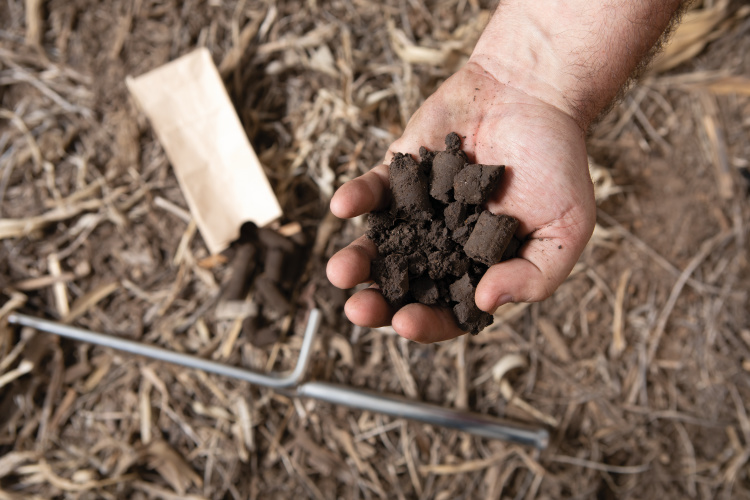
He drives a satellite-guided all-terrain vehicle through fields, marking every stop with GPS coordinates. A handheld probe pulls a cylindrical core of soil from about 6 inches deep. He typically takes samples like this every 2.5 acres on a grid system, meaning an 80-acre field would have 32 samples.
St. Aubin submits the samples to a laboratory, where scientists dry the soil, grind it to a powder and divide it for different analyses, such as for nutrient content and pH, which impacts the availability of nutrients to crops. Data on organic matter can determine how nutrients are held in the soil and help tell a story of soil health.
“I try to educate farmers on soil fertility and, in particular over the last couple years, work more specifically with nitrogen testing in the soil,” St. Aubin says.
Nitrogen can move more easily within the soil profile than other nutrients for crop production. St. Aubin hopes that improved testing methods for nitrogen and his consulting work can help farmers better understand nitrogen availability and lead them to apply nitrogen in ways to effectively reduce nutrient loss.
See more: Today’s Farmers Have the Knowledge to Improve Soil Health (VIDEO)
Soil Stewards

Illinois soils feed the plants that provide the energy for our world’s needs, including food for humans and fuel for cars, says Andrew Margenot, Ph.D., University of Illinois soil scientist.
“Farmers have made remarkable strides in being more efficient in provisioning what plants need,” Margenot says. “It’s stunning that yields have climbed so rapidly.”
Scientists continually work to help farmers determine how they can better ensure the nutrients in the soil are available for the plant to do its job. Likewise, research helps determine the replenishment of nutrients via fertilizers, whether synthetic fertilizers such as urea, a form of nitrogen, or organic sources such as livestock manure, rich in many nutrients.
The scientific community helps farmers finesse and fine-tune their knowledge of soil management for plant nutrition, studying the sources, timing of application and ways to prevent off-farm nutrient losses. Margenot identifies Illinois as a leader in the Midwest in addressing nutrient losses downstream to the Gulf of Mexico, statewide research and partnerships, including the Illinois Nutrient Research and Education Council and the Illinois Farm Bureau. This approach is vital to address the Illinois Nutrient Loss Reduction Strategy goals.
“Farmers in America have a really important job,” Margenot says. “They produce food, fuel and fiber, but they are also stewarding the soil, a really valuable resource for the country.”
See more: How Climate-Smart Farming Practices Help the Planet