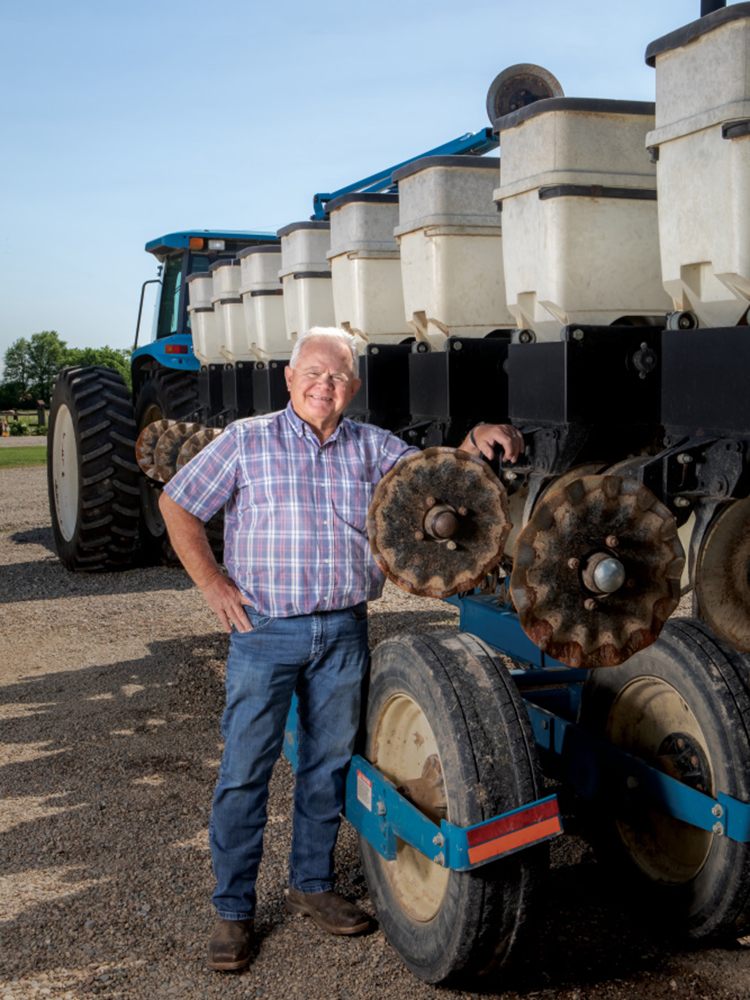
Dennis Green grew up in Lawrence County, where his grandfather settled in the early 1930s. When he graduated from the University of Illinois with a degree in agricultural economics in the 1970s, he returned to the family farm after seeing it as a better business decision than pursuing a job off the farm.
Green talked to Partners about challenges and rewards in production agriculture over the past 50 years and the importance of giving back.
Why did you choose to return to the family farm?
My parents wanted me to go to college to give me options. But, when I graduated in 1974, grain prices were strong. I could make as good a living farming as other jobs I considered in the lending business or working for a supplier. The opportunity was here, so my wife, Debbie, and I came back.
At that time, many thought they should borrow and expand to make it in the future. Thankfully, my dad was a guiding force, and he opposed some things I thought about doing financially. I think that allowed us to survive the 1980s. Unfortunately, a lot of neighboring farms didn’t survive that financial stress. Due to low grain prices and double-digit interest rates, during that time we lost some land we owned that multiple generations had farmed.
See more: Q&A With Cheryl Walsh, the Pig Lady of Peoria County
How has your perspective changed now that your son is interested in coming back to the farm?
A big difference is that he and his family rely on off-farm income rather than the farm itself providing that revenue. I wasn’t looking to expand and was actually looking to slow down. The idea now is that if they want to farm in the future, they’ll have to figure out how to grow the operation.
Why did you make community involvement a priority?
My dad had been on the Lawrence County Farm Bureau board of directors. One day the person who had replaced him stopped and said, “Hey, I’ve been on this board for 10 years. I took your dad’s place. You’re back here, so I think you ought to come on and take my place.” That’s how I joined the county Farm Bureau board in 1976. Pretty soon, they wanted a secretary. I did that for about seven years and then got elected president. We need to work together to accomplish things that, individually, we can’t. That’s one of the biggest guiding factors in getting involved.
It was the same with the local school board. Voters picked me, and I served for 18 years, with 10 of those as president. During that time, we built a new elementary school for the district and laid the groundwork to replace the high school. The main thing is to try to give back to the community. When the opportunity came to serve on the state Farm Bureau board, it still came back to serving others, and the members in my district were generous in allowing me to do that.
What advice might you share with the next generation about work-life balance?
I give credit to my wife, Debbie, for sacrificing her time and allowing me to do these things. When I was younger, my dad and I were farming together, and he was supportive. We encouraged our three kids to participate in extracurricular school activities, including 4-H. I hope our kids learned to give back and share what they have been blessed with. I never wanted to be the largest farmer in the area, but I wanted to be a good farmer. That is what I strived to do. We do the best with what we have.
See more: Q&A with Janet McCabe, a Critical Care Nurse and Farmer